
CryptoStone Protocol
Litepaper
If Bitcoin is digital gold, CryptoStone is building digital gemstones. This readable litepaper explains the protocol thesis, PoM mining model, GEMS metadata, and ecosystem cycle.
Protocol thesis
CryptoStone is an on-chain digital gemstone mining protocol powered by STONX. It translates scarcity, mining, grade, ownership, trade, refinement, and collection into a native crypto experience.
1. Opening Message
Bitcoin asked whether the digital world could create an asset that is scarce, trusted, and verifiable like physical gold. Over time, it answered that question without a central institution, a company guarantee, or hidden issuance rules.
CryptoStone begins with a similarly simple question: if digital gold is possible, can digital gemstones also exist? Gemstones are diverse, graded, discovered, mined, evaluated, collected, and traded through their own value structure.
CryptoStone brings that gemstone concept into the digital world while preserving decentralization, scarcity, verifiability, ownership, and permanence.
2. Digital Gold and Digital Gemstones
Bitcoin did not copy physical gold. It implemented the core properties of gold in a new environment. CryptoStone also does not copy physical gemstones.
CryptoStone implements the essence of gemstones: scarcity, grade, attributes, discovery, mining, ownership, and trade in a verifiable digital structure.
Core Analogy
Digital asset translation
Gold -> Bitcoin
Gemstones -> CryptoStone
3. Returning to the Crypto Essence
The crypto market has become increasingly complex. RWA, DeFi, Layer 2, AI, GameFi, and meme assets all create narratives, but they also require more assumptions and explanation.
CryptoStone chooses a simpler path. It returns to the foundations of blockchain: decentralization, scarcity, verification, mining, security, permanence, and ownership.
CryptoStone does not use physical assets as collateral.
CryptoStone does not rely on a central institution's guarantee.
CryptoStone does not aim to become a complex financial product.
CryptoStone is designed around on-chain ownership and verifiable protocol records.
STONX has no team allocation, no founder reserve, and no hidden insider allocation.
4. PoM: Proof of Mining
Bitcoin built trust in digital gold through Proof of Work. PoW was a great invention, but it also brought energy consumption, hardware competition, and mining concentration.
CryptoStone respects Bitcoin's mining philosophy while proposing PoM, a mining structure based on STONX participation and digital activity rather than large-scale physical electricity.
Users place STONX into gemstone mining pools and accumulate PoM. The current base participation unit is 1,000 STONX. Higher Mining Power can reach claim conditions faster, but it does not let users choose a better grade.
Proof of Mining
STONX to GEMS flow
Acquire STONX
Join Pool
Accrue PoM
Claim
Mint GEMS
Use
5. What Is Mined?
CryptoStone mines 12 birthstones: Garnet, Amethyst, Aquamarine, Diamond, Emerald, Pearl, Ruby, Spinel, Sapphire, Opal, Topaz, and Zircon.
Each digital gemstone receives core grades and attribute values according to protocol rules. Generation combines user-provided entropy, recent multi-block entropy, Ethereum prevrandao, claim state values, and contract-specific values to reduce dependence on any single randomness source.
Metadata
NFT as verifiable gemstone data
6. The Real Asset Is NFT Metadata
CryptoStone uses an NFT protocol because each gemstone needs unique metadata. Images help users identify a gemstone, but the core asset is the grade and attribute data determined by the contract.
Each GEMS can carry grade, attribute, rarity, mining record, ownership record, and transaction history. These data points distinguish one gemstone from another.
The HTTPS metadata API provides readable JSON for wallets and marketplaces, while the watcher finalizes IPFS images and videos. A media delay should not change the gemstone's core identity.
7. Ecosystem Build-Out
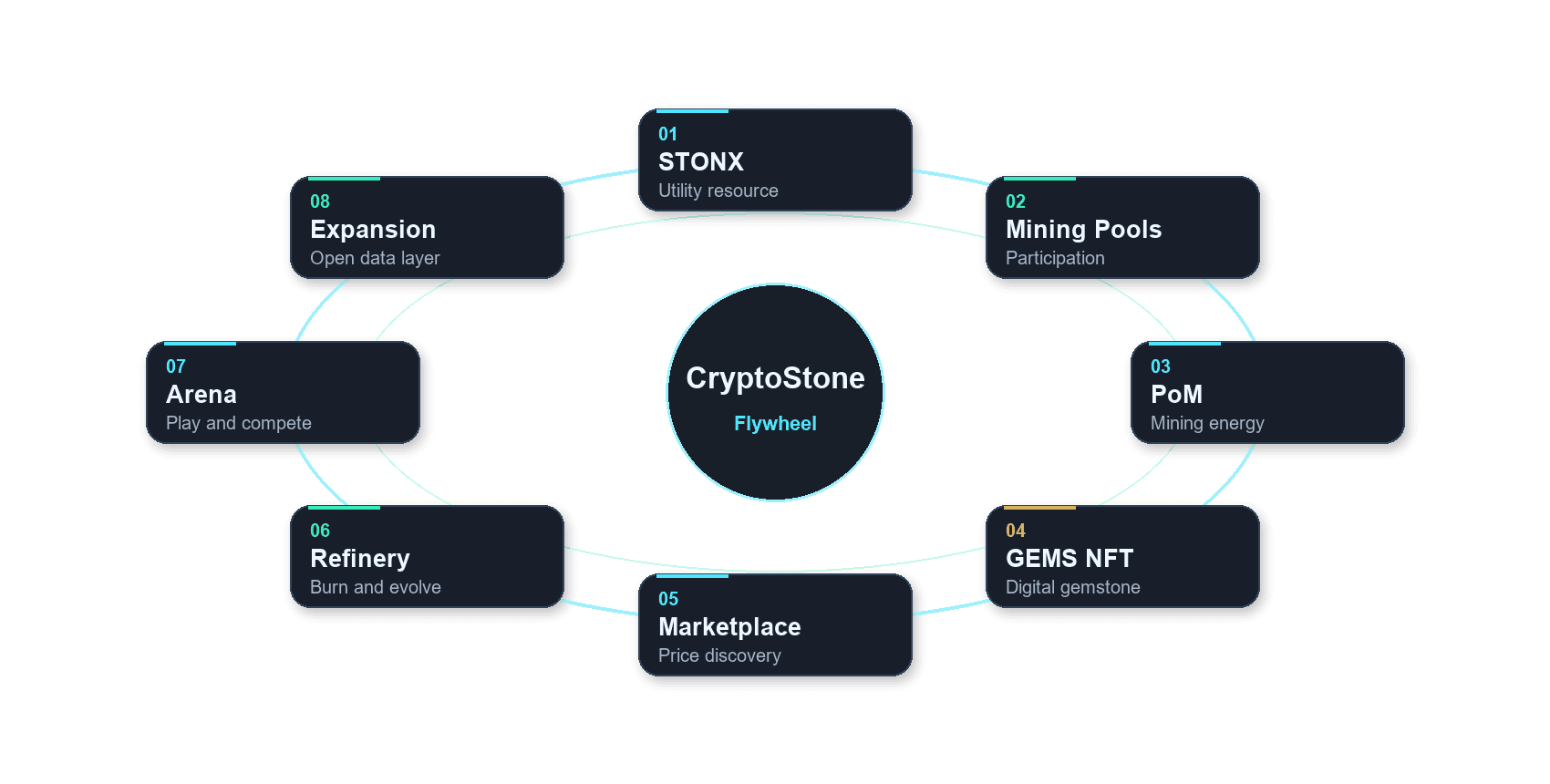
CryptoStone is building the core modules required for a digital gemstone economy: STONX utility, mining pools, marketplace activity, Arena gameplay, and refinement.
STONX is the central utility token of the ecosystem. Users participate in mining through STONX and use it across ecosystem functions.
The marketplace supports GEMS listings and STONX trading. Arena expands utility through gameplay. Refinery burns and evolves gems into new assets.
8. Virtuous Cycle
The CryptoStone ecosystem is designed as a self-reinforcing loop where participation, mining, trading, refinement, gameplay, burns, and expansion reinforce one another.
GEMS are not just issued assets. As records accumulate, each gemstone can carry deeper digital identity and ecosystem use.
Ecosystem
Self-reinforcing protocol loop
9. Why Digital Gemstones Work
CryptoStone can work as a digital gemstone category because it combines digitized gemstone attributes, public scarcity, accessible mining, and compounding trust.
9.1 Gemstone properties can be digitized.
Gem type, grade, weight, clarity, color, cut, rarity, ownership, and trade history can be expressed as digital metadata.
9.2 Ownership and records should be verifiable.
CryptoStone is born in the digital world and is designed around on-chain ownership and PoM records.
9.3 Gemstones are a global asset language.
Birthstones, rarity, grade, color, cut, collection, and trade are easy to understand without complex financial narratives.
9.4 Mining can be lighter and more accessible.
PoM does not depend on large mining equipment or electricity competition. It offers a lighter mining experience under shared protocol rules.
9.5 Experience and trust accumulate.
As GEMS are mined, traded, refined, and used in Arena, data and ecosystem experience accumulate.
10. Positioning and Vision
Bitcoin was not recognized as digital gold from the beginning. Over time, it proved scarcity without a central institution, verifiable issuance, mining-based security, and global ownership transfer.
CryptoStone's goal is not to promise short-term price appreciation. Its goal is to become a digital gemstone standard that can be reassessed as trust, data, and utility accumulate.
CryptoStone is not presented as a great discovery or an entirely new invention. It is a shift in perspective: treating gemstone attributes as the core value of a digital asset.
CryptoStone is an on-chain gemstone category: not a claim on physical stones, not a complex financial product, but a digital-native protocol where gemstones are mined, owned, traded, refined, and used.